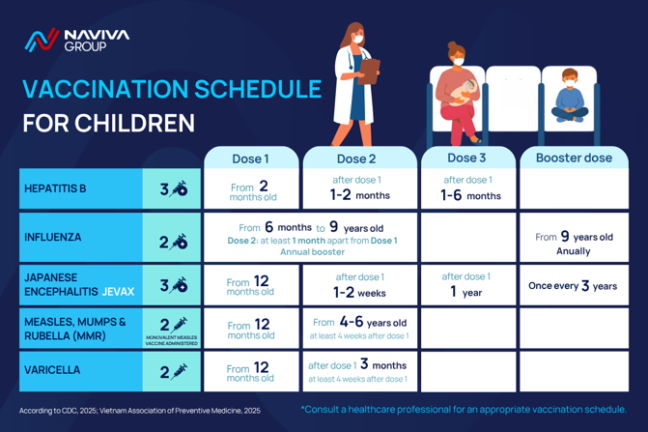
Measles, Mumps, and Rubella Vaccine (MMR – TRESIVAC) is a live attenuated combination vaccine used to induce active immunity against three infectious diseases: measles, mumps, and rubella. The vaccine is indicated for children aged 12 months to 10 years, helping the body develop specific immune responses against the viruses responsible for these diseases.
MMR – TRESIVAC is manufactured by Serum Institute of India Pvt. Ltd. (India). It contains live attenuated measles, mumps, and rubella virus strains and is formulated as a lyophilized powder for reconstitution before subcutaneous administration.
This article provides information on the MMR vaccine, including its composition, indications, eligible recipients, dosage, administration, contraindications, warnings, adverse reactions, drug interactions, and storage conditions. The information is compiled from the manufacturer’s instructions for use.
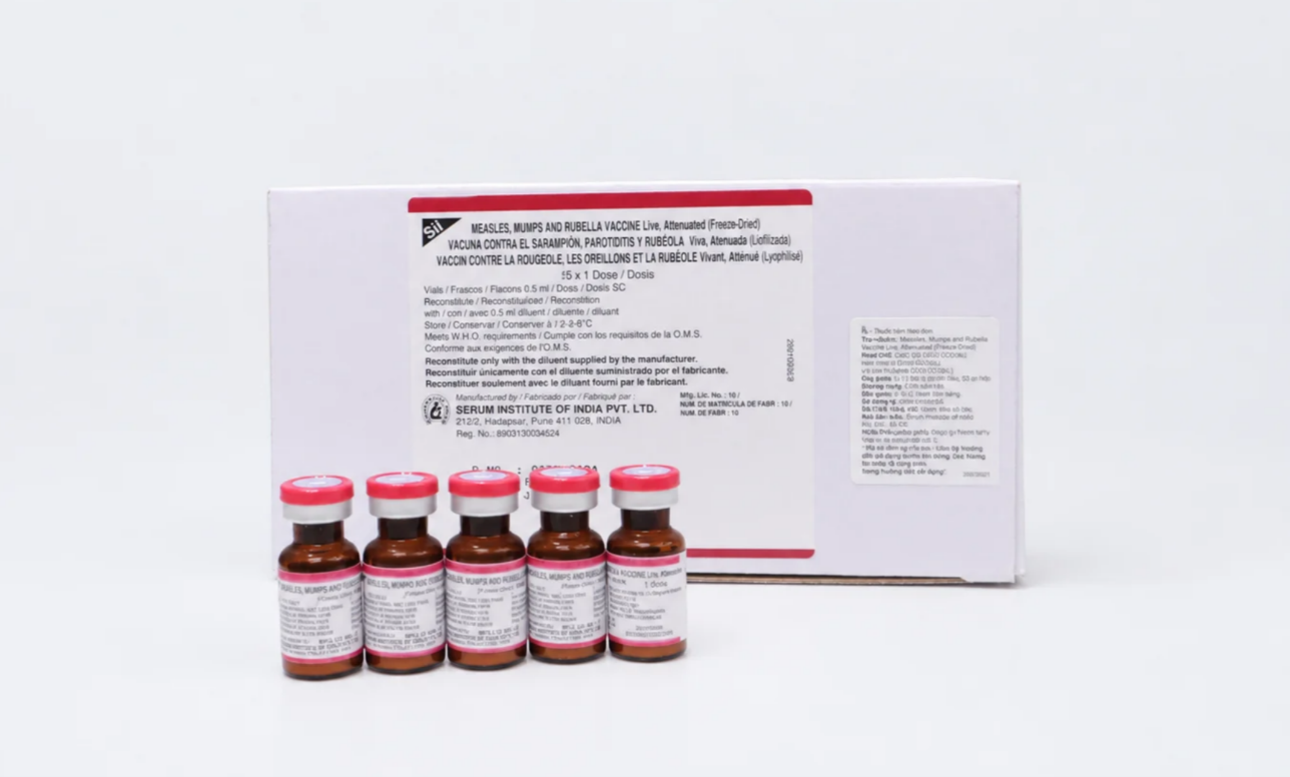
Image: Measles, Mumps, and Rubella Vaccine (MMR)
Indications and eligible recipients
MMR – TRESIVAC is formulated with the Edmonston-Zagreb strain of measles virus, the Leningrad-Zagreb (L-Z) strain of mumps virus, and the Wistar RA 27/3 strain of rubella virus, all of which are live attenuated strains.
The measles and rubella viruses are cultured in human diploid cells, while the mumps virus is cultured in fibroblasts derived from specific-pathogen-free (SPF) chicken eggs. The vaccine is lyophilized and supplied with a diluent for reconstitution. The product is presented as a yellowish-white lyophilized cake.
The vaccine meets the relevant World Health Organization (WHO) requirements when tested using the methods described in WHO Technical Report Series No. 840 (1994).
MMR – TRESIVAC is indicated for children aged 12 months to 10 years.
Recommended vaccination schedule:
- Dose 1: From 12 months of age.
- Dose 2: At 4–6 years of age, or at any time provided that at least 4 weeks have elapsed since the first dose or any previous dose of a live vaccine [2].
Dosage and administration of Measles, Mumps, and Rubella Vaccine
Dosage: 0.5 mL of reconstituted vaccine.
Route of administration: Subcutaneous injection.
Only the diluent supplied with the vaccine should be used for reconstitution. Do not use the diluent supplied with other vaccines or with MMR vaccines manufactured by other manufacturers.
Contraindications and warnings
Individuals receiving corticosteroids, other immunosuppressive agents, or radiotherapy may not develop an optimal immune response.
Vaccination should not be administered to individuals who have a fever, are pregnant, have an acute infectious disease, leukemia, severe anemia or other serious blood disorders, impaired renal function, decompensated heart disease, or who are receiving gammaglobulin or blood transfusions, or those with known hypersensitivity to any vaccine component.
Vaccination is absolutely contraindicated in individuals with a history of hypersensitivity to neomycin or known hypersensitivity to eggs.
MMR – TRESIVAC must not be administered to pregnant women because of a potential risk of teratogenic effects, although this risk has not been demonstrated.
Individuals with immunodeficiency
Vaccination is contraindicated in individuals with severe impairment of the immune system due to congenital immunodeficiency, HIV infection, progressive leukemia or lymphoma, malignancies, or treatment with high-dose corticosteroids, alkylating agents, or antimetabolites, as well as in individuals receiving radiotherapy for conditions associated with immunodeficiency.
Adverse reactions
According to the manufacturer’s information, MMR – TRESIVAC may cause adverse reactions similar to those reported with measles, mumps, and rubella vaccines administered separately.
Common adverse reactions
- Injection-site pain and tenderness: Usually occur within 24 hours and resolve spontaneously within 2–3 days.
- Low-grade fever: Occurs in approximately 5–15% of vaccine recipients, usually 7–12 days after vaccination, and lasts 1–2 days.
- Rash: Occurs in approximately 2% of vaccine recipients, usually 7–10 days after vaccination, and lasts approximately 2 days.
- Arthralgia and arthritis: May occur after vaccination, particularly in adolescent and adult females who lack pre-existing immunity to rubella.
- Other reactions: Parotid gland swelling, lymphadenopathy, myalgia, itching, or general discomfort.
Rare adverse reactions
- Febrile seizures.
- Allergic reactions, such as urticaria, itching, or rash.
- Aseptic meningitis.
- Transient arthralgia or arthritis.
Vaccine recipients should be monitored after vaccination and should promptly inform healthcare professionals if any unusual symptoms or serious adverse reactions occur.
Drug interactions
Individuals who have received immunoglobulins or blood transfusions: The healthcare provider should be informed before MMR – TRESIVAC is administered. These products may contain antibodies that can reduce vaccine effectiveness. The recommended interval before vaccination varies depending on the type and dose of the product received.
Individuals requiring tuberculosis testing: Tuberculin skin testing should preferably be performed before or on the same day as MMR – TRESIVAC vaccination. If testing is performed after vaccination, it is generally necessary to wait at least 4 weeks to avoid potential interference with the test result.
Packaging and storage
Presentation: One-dose vial supplied with 0.5 mL of diluent.
Storage conditions:
- Both the lyophilized vaccine and the reconstituted vaccine must be protected from light.
- Store the lyophilized vaccine at 2–8°C.
- Store the diluent in a cool place and do not freeze it.
Shelf life: 30 months from the date on which the final satisfactory potency test result is obtained, provided the vaccine is stored at 2–8°C.
*MMR vaccine trade name updated to TRESIVAC
Measles, Mumps, and Rubella (MMR) combination vaccine manufactured by Serum Institute of India has been approved for a trade name change from Measles, Mumps and Rubella Vaccine Live, Attenuated (Freeze-Dried) to TRESIVAC.
According to the Drug Administration of Vietnam, the existing MMR vaccine name may continue to be used during the designated transition period. After August 6, 2027, MMR vaccine batches imported into Vietnam will carry the updated TRESIVAC name on the packaging and instructions for use, in accordance with the approved changes.
This change represents an update to the product name and should not be interpreted as a change to the vaccine’s composition, quality, or protective efficacy.
References
[1] Instructions for Use of the Measles, Mumps, and Rubella (MMR) Vaccine, Serum Institute of India Pvt. Ltd.
[2] Vaccination Advisory Letter on the Live Attenuated Measles, Mumps, and Rubella Vaccine, Vaccine and Biological Production Company No. 1 (VABIOTECH).
Disclaimer: This article is for informational purposes only and does not replace medical advice. Vaccination should be preceded by appropriate screening and administered under the direction of qualified healthcare professionals.