Varicella vaccines are live attenuated vaccines that use weakened Varicella-Zoster virus (VZV) to stimulate the body to develop an immune response. However, the virus is sensitive to temperature and environmental conditions, which may cause its potency to decline over time. Therefore, maintaining the potency of the live virus throughout the vaccine’s shelf life is an important quality requirement. [1,3]
Through improvements in manufacturing technology and formulation, the second-generation MAV/06 varicella vaccine has been developed to maintain a minimum potency of 3,800 PFU per dose through the end of its 24-month shelf life, when stored under the specified conditions. [4,5]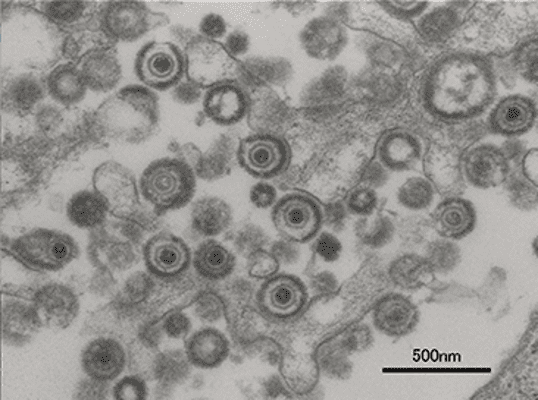
Image: Varicella-Zoster virus viewed under a microscope (Source: taijouhoushin)
1. PFU: An Indicator for Assessing the Potency of Live Virus in Vaccines
PFU (Plaque-Forming Unit) is a unit used to quantify the amount of virus that retains its ability to infect cells under cell culture conditions. This value is measured using a specialized assay based on the virus’s ability to produce areas of damage, known as plaques, in cultured cells. [2]
For live attenuated varicella vaccines, PFU is one of the important parameters used for quality control and for assessing the ability of the virus to maintain its potency during storage. [3]
According to the World Health Organization (WHO, 2025), the minimum live virus potency of licensed varicella vaccines ranges from 1,000 to 17,000 PFU per dose, depending on the individual product. WHO does not establish a single minimum PFU threshold applicable to all varicella vaccines; specific standards are established and approved by the relevant regulatory authorities. [1]
2. Factors Affecting Vaccine Stability
Live attenuated varicella vaccines must maintain viral potency to induce an immune response. However, viral potency may decline over time, particularly when storage conditions are inadequate. [1,8]
Several key factors affect vaccine stability, including:
- Storage temperature: Maintaining the cold chain in accordance with the manufacturer’s instructions helps minimize the risk of reduced viral potency. The second-generation MAV/06 varicella vaccine is stored at 2–8°C. [4]
- Lyophilization technology: Helps minimize changes that may affect vaccine quality during storage. [3]
- Formulation: Improvements in formulation and the selection of appropriate stabilizers contribute to maintaining vaccine quality during storage. Notably, the second-generation MAV/06 varicella vaccine contains urea as a stabilizer, distinguishing its formulation from that of the first-generation MAV/06 vaccine. [4]
In addition, exposure to light and changes in storage conditions may also affect vaccine quality. [8]
What matters is not only the viral potency at the time of manufacture, but also the ability to maintain potency within the required standard until the end of the vaccine’s shelf life.
3. Second-Generation MAV/06 Varicella Vaccine: Maintaining a Minimum Potency Standard of 3,800 PFU for 24 Months
The second-generation MAV/06 varicella vaccine was developed by GC Biopharma (South Korea), incorporating improvements in the production cell line, manufacturing process, and formulation compared with the previous generation. [4,5]
According to a study published in the journal Vaccine in 2021, the second-generation MAV/06 varicella vaccine was developed with a target potency of 8,000 PFU. In addition, South Korean regulatory authorities established a requirement for the live virus potency to remain at a minimum of 3,800 PFU per dose throughout the vaccine’s shelf life. With a shelf life of 24 months when stored at 2–8°C, this is a notable feature of the product’s quality standards. [4,5]
According to information published by the manufacturers, minimum live virus potency standards differ among varicella vaccines. Specifically, the first-generation MAV/06 vaccine has a minimum potency of 1,400 PFU per dose, while the second-generation MAV/06 vaccine has a minimum potency of 3,800 PFU per dose. For vaccines using the Oka strain, the published minimum potency is 1,350 PFU per dose for Oka/Merck and approximately 1,995 PFU per dose for Oka/RIT. [4–7]
Accordingly, the minimum potency standard of the second-generation MAV/06 varicella vaccine is approximately 1.9 times higher than that of Oka/RIT and 2.8 times higher than that of Oka/Merck. However, these differences reflect the individual quality standards of each product and do not imply corresponding differences in clinical protective efficacy. [4,6,7]
According to WHO guidelines, a vaccine’s shelf life must be established based on stability data to ensure that the product maintains its quality specifications under approved storage conditions. [8]
4. Does Higher PFU Potency Mean Better Protection?
PFU potency is an important vaccine quality parameter, but a higher PFU value does not necessarily mean better clinical protection. Vaccine evaluation must consider stability, immunogenicity, safety, and clinical study outcomes collectively.
For the second-generation MAV/06 varicella vaccine, a Phase III study involving 515 healthy children aged 12 months to 12 years reported a seroconversion rate of 97.9% and demonstrated non-inferior immunogenicity compared with the Oka/Merck vaccine used as the control. [5]
Therefore, in addition to clinical data on immunogenicity and safety, the requirement to maintain a minimum potency of 3,800 PFU per dose through the end of the 24-month shelf life is a notable characteristic of the second-generation MAV/06 varicella vaccine.
Maintaining the potency of the live virus within the required standard throughout the shelf life, when the vaccine is stored in accordance with the specified conditions, contributes to ensuring vaccine quality and supporting varicella vaccination programs.
REFERENCES
[1] World Health Organization. WHO position paper on varicella vaccines – November 2025. Weekly Epidemiological Record. 2025;100:567–590.
https://www.who.int/publications/i/item/who-wer10047-567-590
[2] World Health Organization. WHO manual for the establishment of national and other secondary standards for vaccines. 2011.
[3] World Health Organization. Requirements for Varicella Vaccine (Live). WHO Technical Report Series No. 848, Annex 1.
[4] GC Biopharma Corp. Position Paper on MAV/06 Varicella Vaccines, Version 1.0.
[5] Choi UY, et al. Immunogenicity and safety profiles of a new MAV/06 strain varicella vaccine in healthy children: A multinational, multicenter, randomized, double-blinded, active-controlled phase III study. Vaccine. 2021;39:1758–1764.
[6] Merck Sharp & Dohme. VARIVAX – Approved Prescribing Information in Vietnam. 2015.
[7] GlaxoSmithKline. VARILRIX – Approved Prescribing Information in Vietnam. 2015.
[8] World Health Organization. Guidelines on Stability Evaluation of Vaccines. WHO Technical Report Series No. 962, Annex 3.
* SCIENTIFIC INFORMATION FOR HEALTHCARE PROFESSIONALS
This article has been prepared for the purpose of updating and sharing scientific knowledge on live virus potency (PFU), manufacturing technology, and the stability of varicella vaccines. The content is compiled from the cited scientific literature and reference sources. Research data should be considered within the respective conditions and scope of each study and do not replace the prescribing information or instructions for use of vaccines approved in Vietnam.